Manipuri dance
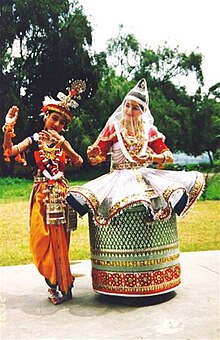
Manipuri Dance is one of the major Indian classical dance. It originates from Manipur a state in north-eastern Indiya. on the border with Burma. In Manipur, surrounded by mountains and geographically isolated at the
meeting point of the orient and mainland India, the form developed its
own specific aesthetics, values, conventions and ethics. The cult of Rada, and Krisna, particularly the raslila, is central to its themes but the dances, unusually, incorporate the characteristic symbols (kartal or manjira) and double-headed drum (pung or Manipuri mrdanga) of sankirtan into the visual performance. Guru Naba Kumar, Guru Bipin Singh, Rajkumar Singhajit Singh, his wife Charu Sija Mathur, Darshana Jhaveri are some of the prominent exponents of this classical dance form.
Manipuri dance is purely religious and its aim is a spiritual experience.
Development of music and dance has through religious festivals and
daily activities of the Manipuri people. According to the legend, the
indigenous people of the Manipur valley were the dance-expert Gandharvas
mentioned in the Hindu epics like Ramayana and Mahabharata. Not only is
dance a medium of worship and enjoyment, a door to the divine, but
indispensable for all socio-cultural ceremonies. From the religious
point of view and from the artistic angle of vision, Manipuri classical
form of dance is claimed not only to be one of the most chastest,
modest, softest and mildest but the most meaningful dances of the world.
The most obliging aspect of Manipuri culture is that, it has retained
the ancient ritual based dances and folk dances along with the later
developed classical Manipuri dance style. Among the classical
categories, 'Ras Leela' - a highly evolved dance drama, choreographed on
'Vaishnavite Padavalis' composed by mainly eminent Bengali poets and
some Manipuri Gurus, is the highest expression of artistic genius,
devotion and excellence of the Manipuris.
Manipuri dancers do not wear ankle bells to accentuate the beats tapped out by the feet, in contrast with other Indian dance
forms, and the dancers' feet never strike the ground hard. Movements of
the body and feet and facial expressions in Manipuri dance are subtle
and aim at devotion and grace.
The early period
A copper plate inscription credits King Khuoyi Tompok (c. 2nd century
CE) with introducing drums and cymbals into Manipuri dance. However, it
is unlikely that the style resembled the form known today before the
introduction of Krishna bhakti in the 15th century CCE. Maharaja Bhagyachandra (r. 1759–1798 CE) codified the style, composed three of the five types of Ras Lilas, the Maha Ras, the Basanta Ras and the Kunja Ras, performed at the Sri Sri Govindaji temple in Imphal during his reign and also the Achouba Bhangi Pareng dance. He designed an elaborate costume known as Kumil. The Govindasangeet Lila Vilasa, an important text detailing the fundamentals of the dance, is also attributed to him.
Maharaja Gambhir Singh (r. 1825–1834 CE) composed two parengs of the tandava type, the Goshtha Bhangi Pareng and the Goshtha Vrindaban Pareng. Maharaja Chandra Kirti Singh (r. 1849–1886 CE), a gifted drummer, composed at least 64 Pung choloms (drum dances) and two parengs of the Lasya type, the Vrindaban Bhangi Pareng and Khrumba Bhangi Pareng. The composition of the Nitya Ras is also attributed to him.
Modern times
This genre of dance became better known outside the region through the efforts of Rabindranath Tagore. In 1919, he was so impressed after seeing a dance composition, the Goshtha Lila in Sylhet(in present day Bangladesh) that he invited Guru Budhimantra Singh to Shantiniketan. In 1926, Guru Naba Kumar joined the faculty to teach the Ras Lila.
Other celebrated Gurus, Senarik Singh Rajkumar, Nileshwar Mukherji and
Atomba Singh were also invited to teach there and assisted Tagore with
the choreography of several of his dance-dramas.
Guru Naba Kumar went to Ahmedabad to teach Manipuri dance in 1928.
Soon, Guru Bipin Singh popularised it in Mumbai. Amongst his pupils,
most well known are the Jhaveri sisters, Nayana, Suverna, Darshana and Ranjana.
The Dance
The traditional Manipuri dance style embodies delicate, lyrical and
graceful movements. The aim is to make rounded movements and avoid any
jerks, sharp edges or straight lines. It is this which gives Manipuri
dance its undulating and soft appearance. The foot movements are viewed
as part of a composite movement of the whole body. The dancer puts his
or her feet down, even during vigorous steps, with the balls of the feet
touching the ground first. The ankle and knee joints are effectively
used as shock absorbers. The dancer’s feet are neither put down nor
lifted up at the precise rhythmic points of the music but rather
slightly earlier or later to express the same rhythmic points most
effectively.
The musical accompaniment for Manipuri dance comes from a percussion instrument called the Pung, a singer, small cymbals, a stringed instrument called the pena and wind instrument such as a flute.
The drummers are always male artistes and, after learning to play the
pung, students are trained to dance with it while drumming. This dance
is known as Pung cholom. The lyrics used in Manipuri are usually from the classical poetry of Jayadeva, Vidyapati, Chandidas, Govindadas or Gyandas and may be in Sanskrit, Maithili, Brij Bhasha or others.

good dance
ReplyDeletemanipurigana mama godak de me blog eken gatha.......................
ReplyDeleteindaiyan dance gana mama vadiya danan hitiye naha
ReplyDeleteimages at karanna.
ReplyDeletegood luck dr...............
ReplyDelete